Monday, 19 August 2019

Maritimes Merriment

​
After our trip to Alberta and British Columbia last year, I mentioned in a WhatsApp group that I wanted to do a roadtrip in the Atlantic Provinces.  DWM's Canadian husband, CWD, first let me know that there were no such things as the Atlantic Provinces, so we could not roadtrip there, but Canada did have lovely Maritime Provinces, and we could roadtrip there.  In June, and only June.  When we realised that World Pride was in June in New York to mark the 50th anniversary of the Stonewall Riots, our next Brexscape holiday was born, and in June Rachel Klem, DWM, CWD, Sushil and I convened in Halifax to kick off our adventure through Nova Scotia and Newfoundland & Labrador.


2019-06-22 142004.jpg
Halifax is the official capital of Nova Scotia, and the unofficial capital of the Maritimes.  It is a medium-sized city, but by some measure the largest in the region.  It's well-formed and compact, snug on a peninsula nestled in a working harbour (whose claim to fame is the deadliest manmade explosion until Hiroshima).  The city is small enough to be eminently manageable, but big enough to have all the trappings of modern urbanity: a growing flat-white economy, sufficient immigration for a full range of quality foodie destinations, plenty of exposed-brick redevelopment, gay bars and, of course, independent coffee shops.  The city has a very midcentury feel to it, and while it is thriving, it's enough out-of-the-way that it seems at little risk of being gentrified or overtouristed out of recognition.  I liked it immensely.


2019-06-22 112113.jpg
We arrived on a gorgeous, cool misty evening to a tree-lined street, which very much had the feeling of being up in the mountains.  The city West of downtown is block after walkable block of well-maintained (and well-priced, per London) Victorian-Americana (continental use of the word) houses bookended by the type of commercial strips that have been Walmarted South of the border.  You can tell there was some suburban-flight decay here as well, but the neighbourhood bones are still there and the Millennial return to urban living is bringing new life and variety to the streets.


2019-06-21 141623.jpg
The North End is Halifax's hipster haven and served as the centre of gravity for our stay.  Like seemingly everywhere else, it was a short walk from our gorgeous house, and is just the sort of neighbourhood that is catnip to the urban set, with a bit of grit still sprouting up through the organic eateries, wine winebars and galleries showcasing local artists.


2019-06-22 143211.jpg
Not to be outdone, across the harbour is Dartmouth, Halifax's answer to Brooklyn.  Reached by ferry, Dartmouth was once its own city, but is now a part of greater Halifax (aka the "Halifax Regional Municipality"), which was formed New York boroughs-style by the amalgamation of Halifax, Dartmouth, Bedford, and Halifax County.  Downtown has a small, but dense, collection of bars, breweries and restaurants.


2019-06-23 174459.jpg
On our penultimate day in Halifax, we got out of town and drove South for lunch in Lunenburg, a too-cute-for-words old fishing town that is now an old artists' haven that is now more of a tourist destination.  The town is snug and colourful, and the downtown is a rotation of cafe, restaurant, gallery, repeat, but it's the kind of place where we quickened our pace to get a table at our chosen waterside restaurant before the tour bus could park and unload its swarm.  We drove up the coast, which was dotted with small villages of varying levels of tourist draw and authenticity, to Peggy's Cove, home of the most famous lighthouse in the Maritimes.


2019-06-25 115749.jpg
After Halifax, we drove along the coast of Nova Scotia, through Cape Breton, and onto a ferry for our overnight ride to Newfoundland, the island half of the province of Newfoundland & Labrador.  We learned that rural Newfoundland is a terrible place for coffee, but an amazing one for scenic drives.  In the middle of our long day's journey was Gros Morne, a rather exceptional bit of a rather stunning landscape.  What took me back the most was the lack of people throughout.  This is one of Canada's biggest and most well-known national parks, and were it anywhere else, it would be swarming with tourists like Banff.  Such is the remoteness of Newfoundland that only a small trickle of other pleased-looking visitors shared the roads and trails with us.


2019-06-26 113627.jpg  
Our next stop in Newfoundland was Twillingate, a small fishing village on an island off (the island) of Newfoundland, where we hoped to see whales and icebergs.  Like in much of the world, the fishing industry has long been mostly absent from town, replaced by tourism - done well, from what we saw.  Though there were plenty of options for paid diversions, the town didn't feel overrun or much outwardly changed.  It felt a bit like an Alaskan village, with unkempt roads and utilitarian (but brightly-coloured) houses, and we did not have to elbow for space amongst the masses.  We managed to see a couple of minkes and one humpback whale on our boat tour.


2019-06-25 212945.jpg
Sushil out back of our totally adorable house.


2019-06-26 115128.jpg
Twillingate has a cafe that must have one of the most stunning views of any cafe in the world.  And - though you can't see it in the pic - just on the horizon we saw an iceberg.


2019-06-26 172418.jpg
En route to St. John's, is the famous(ly-named) town of Dildo (thought to possibly be the anglicisation of d'รฎle d'eau).  If you go all the way from London to Newfoundland, you have to go the extra 15km to get the money shot.


2019-06-27 132341.jpg
A couple of hours past Dildo, after some standard North American suburban sprawl, we rounded a corner on the highway and saw unfold in front of us the most perfect little city on the tiniest of bays, with ships in the dock, hills of ticky-tacky jellybean houses ringing the few towers of downtown, and fog starting to roll in at the mouth of the harbour.  It was totally unexpected, and totally charming; I was instantly smitten.


2019-06-27 161642.jpg
My warmth towards St. John's, capital of Newfoundland and Labrador, only improved walking its streets.  The city is impossibly cute, but not inauthentically.  Which could be surprising, as the town only started painting its jellybeans, as the brightly-hued buildings are known, in the 1970s as a way to bring life into the dying central city.  Again, I think NL's remoteness is its saviour from the overtouristing hordes as we seemed to be largely sharing the city only with its residents.  Though I'd have to be there on a cruise-ship day to really get a fair measure, and I expect George Street would be a bit of a horror on a peak weekend.


2019-06-26 192002.jpg
Besides being adorable and walkable, St. John's has an oddly high concentration of chic and hip bars and eateries.  My foodie/professional chef/adventure eater Mike McGirr and his husband, Travers, rendez-voused with us in both Halifax and St. John's and helped guide our palates to some superb and completely unexpected venues.  I was very open and adventurous on this trip, breaking my pescatarian ways, having my first oysters, mussels, lobster, duck and moose.  When in the Maritimes...


2019-06-26 192430.jpg
"Newfoundland is an island of austere, washed-out beauty and vast unpopulated wilderness. Yet here, in its capital and largest city, one finds scads of homes coloured like tropical fruit, plus bustling street life and a dim urban (yet small-town friendly) buzz. For all that, North America's oldest city doesn't just contrast the province it dominates. St John's exudes wry wit, stoicism and lust for life, and to this end embodies some of Newfoundland's best values."


2019-06-29 151308.jpg
After our Maritime adventure was over, we had a quick weekend hop through New York to celebrate Stonewall 50.  New York fully embraced its place in the rainbow; everything was decked out and bedazzled in the colours of Pride.


2019-07-01 212455.jpg
And a perfect ending to a fantastic trip - we were upgraded to business class on our flight home, our first flat-bed flying experience.  So nice, I didn't even need an Ambien.  I could get used to that...

Thursday, 25 April 2019

[The Life of Shaun #565] The human spark

The print subheadline to this article read "It is not wrong to care more about a building than about people" - perhaps a bit too caustic, and The Economist updated the online article, but I understand the sentiment.  Like many people, I felt terribly saddened seeing Notre Dame in flames, and watching the spire fall immediately brought me back to watching the Twin Towers collapse.

Even with 9/11, a tragedy that took nearly 3,000 lives, much of the talk afterwards was of the loss of the buildings, the hole in the centre of Lower Manhattan.  It's much easier to feel attached to a building you've had a connection with than an unknown person half a world away, however tragic their situation.  Hundreds of millions of people have their own personal story about Notre Dame, and each felt a little private pain when they saw it burn. 

This doesn't mean we shouldn't question what someone donating €200m to Notre Dame's construction is also doing to help those less fortunate.  But that's a question that should be asked regardless of which buildings are or aren't aflame. 

So mourn Notre Dame, and don't feel guilty.  Donate a tenner.  But maybe also set up a monthly donation to your local homeless charity; you don't have to have a spare €200m to make an impact. 

Cheers,
Shaun


The human spark 
Why people care about ancient buildings
The world's reaction to the flames licking around Notre Dame is profoundly human


 Print edition | Leaders

Apr 17th 2019
"What is civilisation?" asked Kenneth Clark 50 years ago in the seminal BBC series on the subject. "I don't know, and I can't define it in abstract terms, yet. But I think I can recognise it when I see it, and I'm looking at it now." And he turned to gesture behind him, at the soaring Gothic towers and flying buttresses of Notre Dame.

It seems inhuman to care more about a building than about people. That the sight of Notre Dame going up in flames (see article) has attracted so much more attention than floods in southern Africa which killed over 1,000 arouses understandable feelings of guilt. Yet the widespread, intense grief at the sight of the cathedral's collapsing steeple is in fact profoundly human—and in a particularly 21st-century way.

It is not just the economy that is global today, it is culture too. People wander the world in search not just of jobs and security but also of beauty and history. Familiarity breeds affection. A building on whose sunny steps you have rested, in front of which you have taken a selfie with your loved one, becomes a warm part of your memories and thus of yourself. That helps explain why China is in mourning—WeChat, young China's principal means of talking to itself, has been throbbing with the story, and Xi Jinping, the country's president, sent a message of condolence to Emmanuel Macron, his French counterpart—while India was largely indifferent. Tourism from India to the West is a trickle compared with the flood from China.

This visual age has endowed beauty with new power, and social media have turned great works of art into superstars. Only a few, though, have achieved this status. Just as there is only ever a handful of world-famous actors, so the pantheon of globally recognisable cultural symbols is tiny: the Mona Lisa (see article), Michelangelo's David, the Taj Mahal, the Great Pyramid—and Notre Dame. Disaster, too, is visual. In the 24 hours after the fire started videos on social media of the burning cathedral were viewed nearly a quarter of a billion times.

Yet the emotions the sight aroused were less about the building itself than about what losing it might mean. Notre Dame is an expression of humanity at its collective best. Nobody could look up into that vaulted ceiling without wondering at the cumulative genius of the thousands of anonymous craftsmen who, over a century and a half, realised a vision so grand in its structural ambition and so delicate in its hand-chiselled detail. Its survival through 850 years of political turbulence—through war, revolution and Nazi occupation—binds the present to the past.

The fire also binds people to each other. The outpouring of emotion it has brought forth is proof that, despite the dark forces of division now abroad, we are all in it together. When nationalism is a rising threat, shared sadness makes borders suddenly irrelevant. When politics is polarised, a love of culture has the power to unite. When extremism divides Muslim from Christian and religious people from atheists, those of all faiths and none are mourning together. An edifice built for the glory of God also represents the unity of the human spirit.

And it will be rebuilt. The morning after the fire, the many Parisians who went to the cathedral to mourn its destruction found comfort instead. Although the spire is gone, the towers are still standing and it seems likely that the whole building can be revived. The effort to rebuild it, like the fire, will bring people together. Within 24 hours, €600m ($677m) had been raised from businesses and rich people, and a rash of crowdfunding campaigns started. A high-resolution laser scan of the building, carried out recently, should help.

It will never be the same, but that is as it should be. As Victor Hugo wrote in "The Hunchback of Notre Dame", a three-volume love-letter to the cathedral: "Great edifices, like great mountains, are the work of centuries. Art is often transformed as it is being made...Time is the architect, the nation is the builder."

--
http://shaunism.blogspot.co.uk/
---
You received this message because you are subscribed to the Google Groups "The Life of Shaun" group.
To unsubscribe from this group and stop receiving emails from it, send an email to the-life-of-shaun+unsubscribe@googlegroups.com.
For more options, visit https://groups.google.com/d/optout.

Sunday, 19 August 2018

[The Life of Shaun #562] Like a cat in the water


I can see it should be fun, I mean I know it should be fun, sweetie.  It's like a secret that no one's let me in on.

- Edina Monsoon, in France


My sisters decided to celebrate their 50th birthdays (separately) in Greece, so Sushil and I planned a holiday around it: Mykonos, Athens and Sifnos. I went to Mykonos in 2006 for Lisa's wedding and had a fantastic time. I was keen to see it again, but also a little bit leery; I'd heard that the island had become a lot more touristy and expensive since I was last there. It turned out to be true, but once we accepted we would be dining on midrange tourist 
shlop and focussed instead on the cocktails, we had a great time. We found a gay piano bar overlooking the Aegean and planted ourselves there nightly. The town and island, though seemingly absent of Greeks, were as beautiful as ever, and we enjoyed substantially contributing to the Greek economy there.


Sushil on a Mykonos street.


Square in Mykonos town.


Leaving Mykonos.


Rooftop dinner for Lisa's celebration.


We had only a quick night in Athens, literally there just long enough for Lisa's birthday dinner, and then to catch a morning ferry to Sifnos, a new island for both of us. Sifnos is a different beast to Mykonos. There are enough tourists to have some interesting bars and restaurants, but you don't feel overwhelmed. It's also an island where people live year-round, so you get glimpses of Greek island life in-between the G&Ts, and the island actually has a functioning, reliable and cheap (€1.80-€3.60/trip) bus service which will take you to all the major settlements, and many small ones en route. As the island has a full-time population of under 3,000, I was really impressed by this.


Sifnos sunset.


The night at the divine Maiolica begins.


Rocking my sunbrella in Kรกstro.


And Pops and me rocking our sun shirts on the birthday boat around the island.


Cheronissos, the fishing village at the top of Sifnos.


Lara's beach birthday dinner.


The full birthday party.


There's not a whole lot to do on Sifnos if you're not a beach person. There are the aforementioned bars and restaurants, but they are limited in number, and certainly in scope once you've had your fill of Greek cuisine. When we hit the first of our horiatiki walls, we parted from the birthday herd and had a fantastic dinner at Maiolica: stunning food, perfectly-selected wine, a table right on the sands of the beach - the unexpected highlight of the week. The rest of the time I read and avoided the sun as best I could, while Sushil and the others sunned and swam. It really is lovely on paper, and I would go again with a group, but I am no beach person. If I'm out of the city, put me up in a mountain or some quirky no man's land. If a beach it must be, then city-adjacent, ร  la Cape Town and Barcelona.  Or better yet, Brighton.  In Winter.

Happy at home on my cool, cloudy rock,
Shaun

Shaun H. Coley ~ Shadwell ~ Tower Hamlets ~ London E1 ~ UK ~ shaunism.blogspot.co.uk

--
http://shaunism.blogspot.co.uk/
---
You received this message because you are subscribed to the Google Groups "The Life of Shaun" group.
To unsubscribe from this group and stop receiving emails from it, send an email to the-life-of-shaun+unsubscribe@googlegroups.com.
For more options, visit https://groups.google.com/d/optout.

Sunday, 10 June 2018

[The Life of Shaun #561] Footbridge at Zaandam

Sushil and I went to see Monet & Architecture at the National Gallery yesterday.  I can't pretend to know the first thing about art, but as Lottie once told me at the Tate, she doesn't always get it, but there's something about the way it makes her feel.  And there is something about being in a grand space, seeing pieces that you know (if not understand) to be great works of art, that stirs inside.  I love watching people and overhearing snippets of commentary, seeing how they take it in; some are very, very serious, but I think most are like me, just there to add a little bit of special into their day.

I ended up being quite taken with one particular painting, Footbridge at Zaandam.  Tucked away in a corner of the second room, smaller and much less vibrant than most of the works on display, I paused in front of it for a polite amount of time before starting to turn to the next one, when my eyes were drawn back.  At the centre, barely discernable against the rest of the painting, stood a lady I hadn't noticed.  Just a few bits of colour almost hidden against the black door, arms cautiously drawn in close to her body, perhaps a bit frightened.  I started wondering about the woman in the painting, who she might have been, what she was thinking, why she looked hesitant.  Was Monet a stranger to her?  Was she worried someone might see her with him?  How did the inside of her house look?  What was her life like?

Throughout the rest of the exhibit, my mind kept wandering back to her, and it occurred to me that with just a few brushstrokes, a life that probably made no other mark in the world had been captured in that painting.  Dear to the people close to her no doubt, any memory of her would have disappeared within a generation or two.  But here I was, almost 150 years later, thinking about her and what the world was for her.  A couple of blotches of paint recorded a life and connected me to someone I never knew and who, if real, died long ago.  I thought that was extraordinary.  And there was certainly something about the way it made me feel.


Footbridge at Zaandam
​
​

Shaun H. Coley ~ Shadwell ~ Tower Hamlets ~ London E1 ~ UK ~ shaunism.blogspot.co.uk

--
http://shaunism.blogspot.co.uk/
---
You received this message because you are subscribed to the Google Groups "The Life of Shaun" group.
To unsubscribe from this group and stop receiving emails from it, send an email to the-life-of-shaun+unsubscribe@googlegroups.com.
For more options, visit https://groups.google.com/d/optout.

Monday, 7 May 2018

[The Life of Shaun #560] Why I Spent Six Years Making A Documentary on Circumcision

In honour of the 2018 World Wide Day of Genital Autonomy, I am sharing the below from Brendon Marotta, director of the film American Circumcision.  The film has just completed a successful tour of America, including winning best documentary at the Lone Star Film Festival, and will be coming out on Netflix and Amazon later this year.  Sign up for updates to be notified when the film is released (and see my name in the credits!), or make a donation to help spread the word and save a child from non-consensual genital cutting:


Keeping up the fight for everyone's right to their own bodies,
Shaun


Why I Spent Six Years Making A Documentary on Circumcision

​
When people hear that I've made a documentary on circumcision, one of the first questions they usually ask is "why did you decide to make a film about this?"
In the past, it has been a difficult question for me to answer, not because I don't have strong reasons, but because I don't know how anyone could know what I've learned and not make this film.
Imagine for a minute that there is an issue that affects every man in America, every person who loves a man, and every parent, child, and family, and that no one had ever made a major documentary about this issue. Wouldn't you want to make a film about that?
Now imagine that this issue affects men in the most deeply personal way possible. That it causes us pain as children, permanently alters our sexuality, literally scarring us for life. People are afraid to speak about this issue publicly, but everyone knows what it is. Regardless of where you fall on this issue, we have a responsibility to talk openly and honestly about it.
​

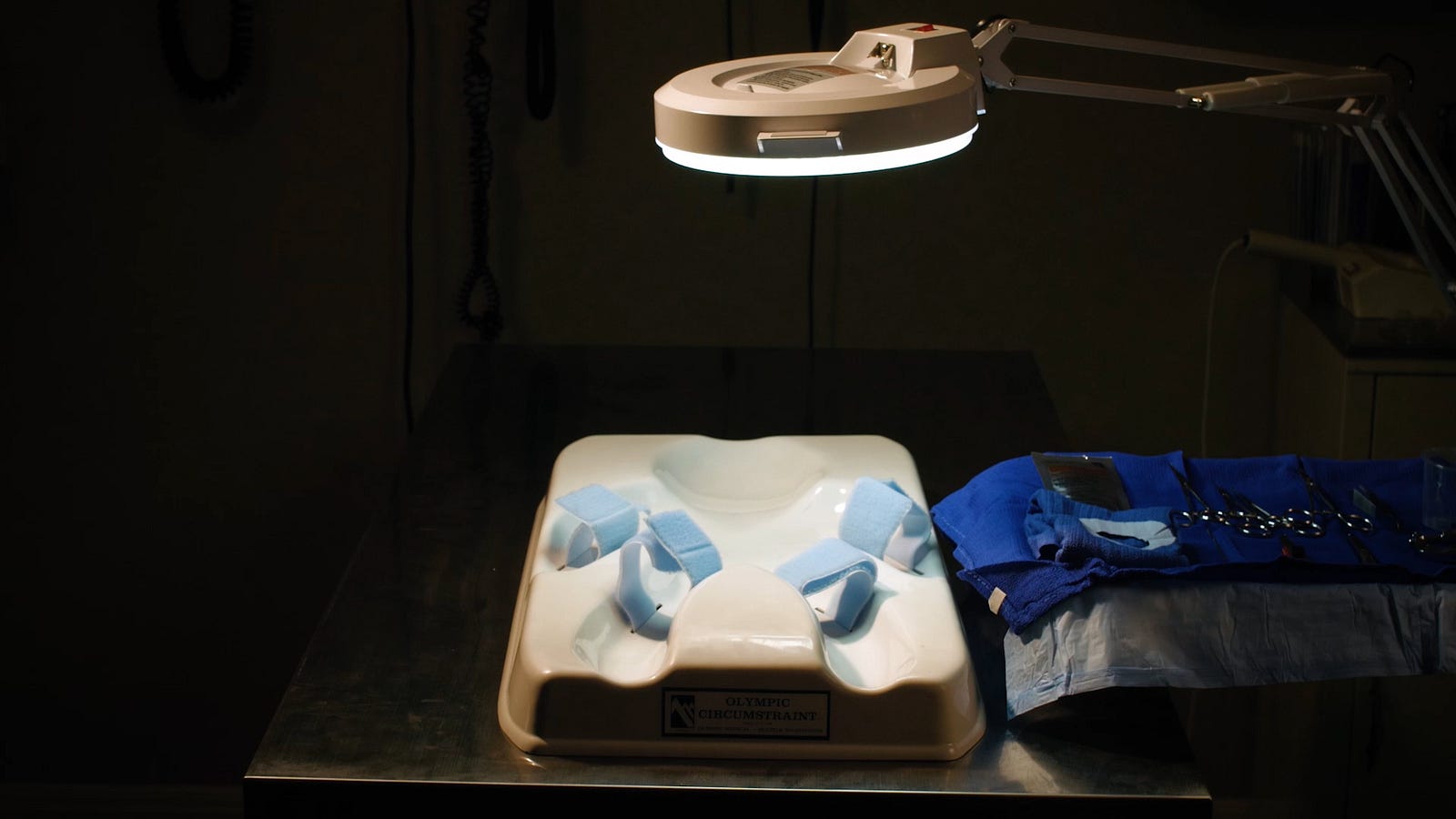
The circumstraint, a device babies are strapped down to when circumcised.

​
When you begin discussing this issue, you'll find that people have false beliefs about even the most basic facts. People will try to claim that circumcision does not involve cutting or removing tissue, that there isn't a specially designed board children are strapped down to when this is done to them, or that circumcision hasn't often been done without anesthetic. People are naturally repulsed by what this does to children and find it nearly impossible to integrate the truth about circumcision into their day to day life.
When I first began working on this film, I thought I would just share information with people, and then they would understand. What I found was that people are resistant to even learning new information. They fear what they might discover.
In our culture, men are only allowed to have one feeling about circumcision: "I'm fine with it." But what does it mean if you aren't fine? What happens when you allow yourself to explore the full range of emotions you feel about circumcision?
When circumcision is discussed in American media, it is typically viewed as a one time decision that parents make and never have to think about again. The truth is it's more like dropping a stone in a pond — a decision that ripples through that man's life — through his sexuality, his body, his self image, his relationships, his feelings, his culture, religious institutions, medical institutions, and even through the laws of his country — for the rest of his life. This film looks at these ripples echoing through time affecting our social order and our intimate relationships — the feelings we're not allowed to explore.
What I've learned by working on this project for over six years is that on the other side of these questions there are answers. The challenges presented by this problematic and painful procedure have solutions, which seem simple and clear when we are present with our feelings. I invite you to explore those feelings with a variety of perspectives I've gathered from interview subjects all around the world. If you approach with an open mind, you might find these people have something to teach you about circumcision and yourself.
Brendon Marotta
Director of American Circumcision
​


Education leads to protection of boys

The trivializing term "circumcision" stands for the amputation of the foreskin of the penis, which involves the loss of approximately 50% of the entire penile skin - including the parts most sensitive for sexual stimulation - and irreversibly alters the natural physiology of the penis and its appearance. Possible psychological late effects have also increasingly been documented.

Currently, about 600 million to 1.2 billion males worldwide are affected, based on tradition, religion or, most recently, highly negligent HIV prevention programs in Africa. Foreskin amputation has become a mass phenomenon only in cultures and societies where it is performed on children, meaning without the mature and informed consent of the person who solely has to endure the assault and live with the consequences forever. This is particularly the case in the United States of America and parts of Africa and Asia. Little known in the Western world is the fact that around 65,000 boys in Africa are likely to be seriously injured every year and that several hundred boys do not survive this ritual.

Total foreskin removal is medically avoidable except in very rare cases.  A snug or non-retractile foreskin does not constitute a medical condition in children and adolescents if a boy has no painful obstruction, which is a rare condition. Usually the opening becomes wider until the end of puberty. In instances of an actual medical condition, most cases can be treated non-invasively.


Shaun H. Coley ~ Shadwell ~ Tower Hamlets ~ London E1 ~ UK ~ shaunism.blogspot.co.uk

--
http://shaunism.blogspot.co.uk/
---
You received this message because you are subscribed to the Google Groups "The Life of Shaun" group.
To unsubscribe from this group and stop receiving emails from it, send an email to the-life-of-shaun+unsubscribe@googlegroups.com.
For more options, visit https://groups.google.com/d/optout.

Sunday, 6 May 2018

Gahara Peechha

"Every city in the world has a village in its heart.  You will never understand the city, unless you first understand the village.  Go there.  When you return, I will see what India has made of you.  Bonne chance!"    

-Shantaram


After three years, I went back to India - Sushil's and my first visit back to India together - for the wedding of Sushi's best friend, Rajat.  As the wedding was taking place (relatively) close to Sushil's home, we took the occasion for Sushil to show me where he's from.

Sushil's village is quite remote, so to reach it you need to take a 5+ hour bus ride from one of the nearish airports.  Fortunately, one of those airports is in Chandigarh, a city I've been quite keen to visit.  Akin to Brasรญlia and Canberra, Chandigarh was built in the 20th century as a capital city.  Straddling the border of the states of Punjab and Haryana, it is capital to both, and was designed by Le Corbusier, often considered giving birth to the modern brutalist architectural movement with his Unitรฉ d'Habitation.  The city has a special significance in India as it was built after the partition of British India into India and Pakistan, and the states it would govern became home for a large part of the millions of people who fled or were forced out of Pakistan.    

Being a planned city with street grids, sectors and roundabouts, Chandigarh is a surprisingly calm, clean and sprawling city for India.  It's also relatively rich (or perhaps, just more firmly segregated, like Brasรญlia), with no slums or street families.  The city has its fair share of under-maintained, crumbling buildings, but it also has broad avenues connecting parks, lakes and other leisure spaces.  It almost doesn't feel like India at all.


Map of Chandigarh showing its master plan.


The Gandhi building at the university.


A mini Eiffel Tower in a park, in honour of Le Corbusier.


Le Corbusier sculpture park.


Architecture museum.


Solitary man sweeping the large plaza in the arts compound, with the modern art museum behind.


Performance hall.


The Rock Garden of Chandigarh was constructed by Nek Chand, who had fled from Pakistan at partition.  "In his spare time, Nek Chand started collecting materials from demolition sites around the city. He recycled these materials into his own vision of the divine kingdom of Sukrani, choosing a gorge in a forest near Sukhna Lake for his work. The gorge had been designated as a land conservancy, a forest buffer established in 1902 that nothing could be built on. Chand’s work was illegal, but he was able to hide it for 18 years before it was discovered by the authorities in 1975. By this time, it had grown into a 12-acre (49,000 m2) complex of interlinked courtyards, each filled with hundreds of pottery-covered concrete sculptures of dancers, musicians, and animals."


High Court of Punjab and Haryana, in the Capitol Complex, the brutalist heart of Le Corbusier's city.


The Open Hand Monument, "the emblem...of Chandigarh and symbolizes 'the hand to give and the hand to take; peace and prosperity, and the unity of mankind'".


Palace of Assembly.  The assembly of Punjab meets under the round tower, and Haryana's under the triangular one.  The structure on the left is the Tower of Shadows, a monument built to showcase the architectural devices used in the capitol complex to guard against the city's aggressive Summers.  As soon as you walk inside, you feel the air temperature drop.


Secretariat Building, where Chandigarh's mandarins toil.


On the rim of Sukhna Lake, manmade for the enjoyment of the capital's denizens, complete with boat rentals and a lakeside country club for the elite.


Sushil and his brother, Panku.  Sushil's brother lives and works in Chandigarh, so we met up with him there before heading off to the village.  He was the first of the Thakur clan that I was to meet in the coming days.


From Chandigarh, we took a winding, weaving bus ride (sick bags were passed out and audibly used en route) to Sunder Nagar, Sushil's regional town.  After loading up on beer, bottled water and toilet paper, it was a 20-minute taxi ride along a narrow, precipitous, single-lane road to Sushil's village, Bhanglehra.  On one of my trips to India, before we were married, Sushil casually mentioned to me about "when they built the road to his town, about 10 years ago".  Learning that the village didn't even have a road until into the 21st century really made me realise how remote Sushil's village was, so riding along this rural lifeline was quite poignant and surreal.     

As it turns out, the road doesn't actually go to the village, but next to it, on the top of an overlooking ridge.  The only way to navigate the village is via dirt footpaths down the hill from the road, winding amongst the houses, fields, stream and various farm animals of Bhanglehra.  From what I could tell, other than a couple lower-caste homes on the outskirts, the village was made up entirely of Sushil's relatives.  His grandparents live directly behind his family home, and his aunts, uncles, cousins and their children lived in the rest.  As children marry and families grow, most people don't move, but instead build a house next door, or, like Sushil's parents, add another level to the exhisting house.  The result is a collection of colourful, spacious houses that most Londoners can only dream of, but conspicuously short of possessions, as the region's legal minimum wage of ~£2 ($3) per day might imply.    

As the villagers (ie, family) go about their days, they walk amongst the houses and shout out to see if anyone's home, or ask a question.  Several of his cousins, and soon his brother, have settled into their arranged marriages, built homes next to their parents, and made a life for themselves with blue collar jobs in Sunder Nagar, supplemented with some crops and dairy from the fields and animals they tend.  There's an overwhelming sense of insularity and acquiescence in the village, like leaves floating down a stream; they've been set on a life path, centred around marriage, and peacefully and unquestioningly follow it.  On the last night in the village, Sushil’s father was, not for the first time, telling me in basic English that Sushil needs to be married within six months (sometimes it was four).  I asked if it wasn’t important for each person to also be happy in life, and he looked at me a bit uncomfortably answered “No.  No.”, and then told me his society expected it of him.      

It must be terribly hard for him, but I can say I am so proud of, and amazed by, Sushil.  Seeing the village, and meeting its people and their tiny, tiny world, it truly is amazing that Sushil has done what he has, moved away to Mumbai and now London, and has the mindset he has.  He’s truly exceptional.   And also very lucky that his parents elected to send him to the English language school rather than the Hindi.  His world of opportunities is so much larger than his Hindi-speaking cousins left in the village.  Everyone's life is a roll of the dice to some extent, but Sushil took that lucky roll and worked hard to turn it into a life for himself that he loves, in which he's comfortable and honest, and which would be unfathomable in the village.


The hills of Sushil's home state, Himachal Pradesh.


Sushil's father outside their house.


Sushil looking out at their fields.


Sushil's mom in her kitchen.


The grandparents' house, and Sushil's grandfather on the terrace.  His back is permanently bent at that angle, he can't get any more erect.  Life was very hard in India two generations ago.


My favourite bit of the house was this portal between the dining room and the kitchen where the men could request things from the kitchen.  Here Sushil is exchanging our dirty dishes for a bottle of beer.


There is no hot water in the house, so to bathe you first heat up a bucket of water with an immersion heater, and then wash yourself using a pitcher to scoop water from the bucket.


The road, heading out from the village towards Sunder Nagar.


Sunder Nagar


Sunder Nagar only has two big roads, the state highway and this shopping street, which feels like so much of urban India.


One of Sushil's cousins drove us around the area one day and we stopped to have some drinks at a restaurant with a terrace.  When I saw this guy there, I was shocked to see another tourist, as I hadn't since Chandigarh.  But turns out he's wasn't a tourist - he was our waiter and was as Indian as Sushil, right down to speaking the local language.


View from the terrace.


Sushil enjoying a local treat.


Me with the "suburbs" of Sunder Nagar behind.


On my last night, we got the whole clan into the dining room for dinner.        


Last, but not least, before going home, was Rajat's wedding, a full-on, multi-day affair.  Unfortunately, due to our work restraints and the timing required by the bride's and groom's stars, we were only able to attend the first (but most important) ceremonies.  The wedding was very much what you expect of an Indian wedding: huge, boisterous, colourful and accompanied by a neverending supply of food (and total dearth of alcohol).  It was great to see Sushil relax a bit away from the family, and to laugh and banter with his university friends.  One had decent English, so I was even able to give Sushil a bit of a break from summarising lengthy conversations into a sentence or two.    

By the end of the week, we were both ready to get back to London - out of the heat, back to our life together, and to take a break from curry.  The wedding also being in rural Himachal Pradesh, this of course meant a two-hour taxi ride to Shimla, then a flight to Delhi, connecting flight onward to Mumbai, where we stayed overnight before flying back to London.  Accessible, it ain't.  But worth every effort.


Traditionally, the groom would arrive at the bride's home on a white horse.  In modern India, a white sedan is the norm.


In our full wedding finest!


I loves me an Indian buffet!


The bride and groom, suitably understated.