Tuesday, 9 December 2014

[The Life of Shaun #504] Pervin' in Rio

Rio is a great city to discover that your camera's zoom works great as a pervin' lens: the beautiful city attracts the beautiful people.

Rio de Janeiro - the January River - was the city on the tour I was the least excited about.  The urbanist in me was fascinated by the megacity of São Paulo, the amateur architecture enthusiast was dazzled by piles of Brasília, and the laid-back tourist wanting wine, food and song with his friends was looking forward to the gentle Buenos Aires.  But sun, beaches, tans and gym bunnies?  That's not what makes it onto my itineraries.  However, Rio is a must-do, and I was excited to see the undeniably striking topography, and to see Brazil's take on slums with a favela our.

Rio is the point where Rachel Klem and Darrin Wayne Maurer met up with Russ and me for the second half of the adventure.  From the moment our beautiful host showed us into our beautiful flat with its beautiful view, the mood for the weekend was set; I was helpless against the charms of the Marvelous City.

Rio de Janeiro's beauty cannot be oversold.  It's set around the mouth of a large bay, too big to see across, giving it the feel of an island city.  Improbably steep mountains jut out from the ocean, creating an undulating coastline of peaks and valleys, around and across which the city is set, encirlced by white sandy beaches.  Everywhere you go in the city you are aware of elevation and sea.  The architecture is pleasant, but innocuous; there is little to excite you, but nothing to offend you either - the architecture takes a backseat to the setting.  I lived in San Francisco, and have been to Sydney and Seattle, all of which are gorgeous cities in their own right, but the scale and spectacle of Rio put them in its shadow.

The three happiest things I found out about Rio were that it's not always sunny, it's very easy for a vegetarian to have great food, and the beaches and their culture are not the dominant factor in the city's character.  Perhaps it's because they are so copious, but they are given over to myriad activities and uses, not just for tanning the beautiful.  There is so much going on away from the beaches, though, that we actually spent next to no time at them.  We stayed in Ipanema, which is host to one of Rio's two famous beaches (the other is its neighbour, Copacabana), but which had a surprisingly un-beachy, if not bohemian, atmosphere.  

The area is packed with bars and restaurants, and though the businesses nearest the beach were obviously bent towards tourists,  you saw mostly locals going about their lives, walking their dogs, taking a lunch break, carrying supplies home after a show.  It's not showy or glossy or narcissistic; it's vibrant, but relaxed and satisfied, somewhere that I could imagine living.  That's not something I often say about a beach city.  While I can't colour all of Rio shades of Ipanema, the city is absent of São Paulo's fear and tension, and much of the rest of the city we saw had the agreeable feel of Ipanema; even the favelas had an alegria de viver about them.  Cariocas, as Rio's inhabitants are called, know what a lucky place they call home.


Sugarloaf Mountain sits at the mouth of Rio's harbour...


..and is a rickety ride up two separate cable cars...


...with one of Earth's most stunning urban views as your reward at the top.


Flying out, you can see the shape of Rio.  Ipanema is the beach on the lower left; Copacabana is to its right; Sugarloaf to the right of that; and the urban core above that is downtown Rio de Janeiro, where the city was founded.


Heading out on our favela (slum) tour, we started to ascend the hills and caught a view looking down on Rio.  Paradoxically, in many Latin American cities, the favelas are high above the cities, commanding the best views.  This is a hangover from the days of poor transportation, when the only viable way to get home was to walk.  Much like New York's prewar walk-ups, the higher up you went, the cheaper it got.


The favelas spread up an over Rio's hills, built on any incline that could possibly support a home.


Though obviously poor, there is no destitution like you see in India's slums.  Many of India's normal streets and homes are in far worse shape than Brazil's favelas.  This was not always the case; up until several years before the World Cup, Rio's slums were notorious ganglands.  In preparation for the World Cup in 2014, and Olympics in 2016, Rio began pacifying its favelas, routing out the druglords, bringing a sense of peace, and installing running water and electricity.


Around 80% of Rio's favelas are now "pacified", and safe enough to walk around...


...and have a drink in.


The view from our flat was one of the views, of Christ the Redeemer - when it broke through the clouds, that is.


A ten-minute stroll away was the incomparable Ipanema beach.


But we soon found the most beautiful view from the flat was out a back window.


Rio has a great bar scene, where we had the most fun on the trip.  Even Rachel got oodles of attention!


This will always be known as the trip where Russ spilled and I did not!


Ah, but what would Rio be without a beach shot?


Or two?


Or outside a café?


Or in?


But despite all our best efforts, not everything was a success; the man just outside Rachel's room's window...


...is the one that got away...


Shaun H. Coley ~ Kentish Town
 ~ Camden ~ London NW5 ~ UK ~ shaunism.blogspot.com

--
--
You received this message because you are subscribed to the "The Life of Shaun" group.
To unsubscribe from this group, send email to The-Life-of-Shaun-unsubscribe@googlegroups.com
For more options, visit this group at http://groups.google.com/group/The-Life-of-Shaun
---
You received this message because you are subscribed to the Google Groups "The Life of Shaun" group.
To unsubscribe from this group and stop receiving emails from it, send an email to the-life-of-shaun+unsubscribe@googlegroups.com.
For more options, visit https://groups.google.com/d/optout.

Friday, 5 December 2014

[The Life of Shaun #503] Brasília

Prior to the trip, the nerdy, urbanist side of me was most excited about the second stop of the birthday adventure, Brasília, the modernist, master-planned capital city of Brazil.  Salvador was the original capital, but it was moved to Rio de Janeiro in 1763, where it stayed for almost two hundred years.  (During the Napoleonic invasion, Rio even served as the capital of the Portuguese Empire, rather than Lisbon.)

During the last decades of Rio's run as capital, the idea was floated to build a new capital inland, to pull power away from the dominant Southeast coast, and to spur development of the poorer interior.  Despite being written into Brazil's post-colonial constitution, the proposal to move the capital came to naught until Juscelino Kubitschek, the "father of modern Brazil", ordered the construction of the new capital as part of his manifesto of "fifty years of progress in five."  Lúcio Costa won the contest for the master plan, and his close friend and modernist darling, Oscar Niemeyer, designed the main buildings within.

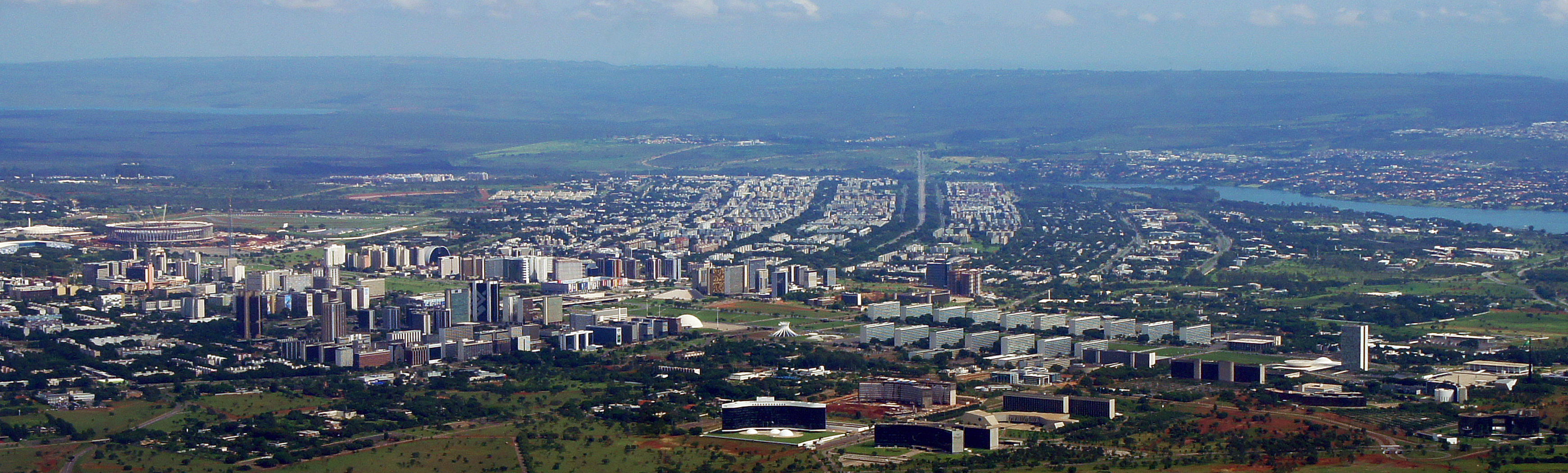
Born at the beginning of the jet age, Brasília was made in the image of an airplane, its fuselage stretching East-West, with the nose of the plane jutting into the man-made Lake Paranoá.  The spine of the fuselage is the Eixo Monumental (Monumental Axis), a wide strip of parks and roads along which most of Brasília's important buildings are spread.  The two wings, North and South, arch off the Eixo Monumental, and contain most of the city's hotels, residential areas, and entertainment centres.  It's very Utopian, and emblematic of the midcentury ideal of the automobile as modernity.  

From nothing, the city has exploded into a metropolitan population of four million in a little over fifty years.  The city proper is relatively expensive, and surrounded by a greenbelt.  Poorer sattelite cities and favellas sit a comfortable distance away from the centre.  Connected by bus and train, they serve as the homes for most of the workers who service the city.  The commute is so one-directional that hundreds of busses come into the city each morning, disgorge their passengers, and then sit in giant parking lots until taking their passengers back home in the evening, where the busses rest overnight.

Since learning about Brasília many years ago, I have been keen to see it in person.  The city is surprising in several ways: it's much larger than I expected it to be, and the iconic architecture for which it is famous is much smaller.  The heavy-handed symbolism of the airplane is less obvious and more agreeable on the ground than I imagined, and the city itself, while sprawling, was more pleasant and lively than a young, inorganic, car-centric city would be expected to be (think Milton Keynes, or Canberra).  We were there for three days, and part of me thought that might be excessive.  But in the end, it wasn't; there was enough to see in the day, and plenty of diversions in the evening, to keep Russ and me occupied and happy.  Even after years of anticipation, Brasília did not disappoint.


Looking down the Eixo Monumental towards Brazil's National Congress building, the apex of the avenue.


The North "wing" radiating out from the "fuselage" (from Wiki).


Brazil's National Congress building.  "The semi-sphere on the left is the seat of the Senate, and the semi-sphere on the right is the seat of the Chamber of the Deputies.  Between them are two vertical office towers. The Congress also occupies other surrounding office buildings, some of them interconnected by a tunnel...The dome that opens to the sky sym symbolises e deputies’ openness to the people, while the upside down dome symbolises reflection."  Unfortunately, due to regular protests in the capital around our visit, only organised school tours were being allowed inside the complex.


Two similar, but different, Niemeyer buildings flank the National Congress.


Rows of ministries (two per building) stretch along both sides of the Eixo Monumental.


Russ and I in front of the Cathedral of Brasília.  The cathedral is symbolic of the crown of thorns; the bell tower to right of the wine from the Last Supper; to the left, out of frame, is a structure representing the loaf of bread.  (Incidentally Niemeyer was an atheist.)


Inside the cathedral.  The pews are relatively recent additions; they were seen by Niemeyer to clutter the space, so worshipers originally had to stand, or sit on one of a very few pedestals around the edge.


The National Museum of the Republic sits on one side of the Cultural Complex of the Republic.  Unfortunately, again, there was no exhibit on while we were in town, so I could not go inside.


Palácio da Alvorada, the official residence of the president of Brazil, protected by a moat (with guards at both ends) rather than a fence.  Water features are very common in Niemeyer's work.


For the Niemeyer fans, this is the only hotel in the city he designed, the Brasília Palace Hotel.  I considered staying there, but it's far from the city centre and got lack lacklustre reviews.  Judging by its empty parking lot, this is a very common decision.


The spectacular Estádio Nacional Mané Garrincha, designed in the style of Brasília.


The Juscelino Kubitschek Memorial, and final resting place of the father of modern Brazil.


Niemeyer was sure to design handsome, copious buildings for the country's military.


The Santuário Dom Bosco, or "Blue Church", appears a concrete cube outside...


...and it's not until you step inside you see where its nickname comes from.


The residential sections of Brasília are divided into organised groups.  Eleven buildings make up a superblock, "each group of four superblocks was supposed to serve as a single neighbourhood unit.  Each group was to have a church, a secondary school, a movie house, a youth club, and adequate field space for children to play sports on.  Between the superblocks were lower buildings for commercial businesses. Each superblock's six-story buildings rested on massive pillars, so there was an open area beneath the building for the free movement of pedestrians and for children to play under during inclement weather. The superblocks were also intended to be egalitarian, so that people of all income levels would live together and interact without class distinctions."


One of the sections of "lower buildings for commercial businesses".  Many were outwardly unappealing, but I managed to fine a good wine bar, pub and Asian restaurant within them.


The elegant Juscelino Kubitschek Bridge crosses the Lake Paranoá, connecting the city centre with wealthy homes on hillsides overlooking the capital.


Shaun H. Coley ~ Kentish Town
 ~ Camden ~ London NW5 ~ UK ~ shaunism.blogspot.com
--
--
You received this message because you are subscribed to the "The Life of Shaun" group.
To unsubscribe from this group, send email to The-Life-of-Shaun-unsubscribe@googlegroups.com
For more options, visit this group at http://groups.google.com/group/The-Life-of-Shaun
---
You received this message because you are subscribed to the Google Groups "The Life of Shaun" group.
To unsubscribe from this group and stop receiving emails from it, send an email to the-life-of-shaun+unsubscribe@googlegroups.com.
For more options, visit https://groups.google.com/d/optout.

Tuesday, 25 November 2014

[The Life of Shaun #502] São Paulo

I decided a couple years ago that, before I turned 40, I wanted to visit South America, thereby visiting all the inhabited continents before middle age (or the "old of the young", I am told).  It seemed somehow fitting of my wanderlust to close that circle, and at the same time of recognising the milestone.

Russ joined me for the first stop, São Paulo, Brazil's economic and cultural powerhouse.  The city is massive, the centre of a conurbation of 28m people, with a further 14m in the surrounding state, accounting for fully 1/3rd of Brazil's GDP.  And yet, outside the recent World Cup matches hosted in its stadium, you rarely hear about it, as it's so in the shadow of its flamboyant neighbour to the Northeast, Rio de Janeiro.  

Glancing at pictures of the cities, it's easy to see why; São Paulo has none of the topography or beaches that make Rio so dazzling.  However, this concrete jungle is a much more manageable and nuanced collection of neighbourhoods than its profile belies.  Spread out across rivers and rolling hills, you casually and imperceptibly slip between different areas and moods of the city, each of which feels complete and content.

One facet of Brazil in general, and São Paulo in particular, that you never hear the end of is crime.  Brazil is a middle-income country, with an outward veneer of Western prosperity.  Underneath, though, lies third-world inequality, and the desperation that brings.  My guide book suggested 'accept the fact that you might get mugged, and never carry more with you than you need', couching the suggestion in terms of empathy towards Brazil's poorest.  Everyone we met in São Paulo told us to be careful, especially in the centre where we were staying.  There are outward signs of this reality everywhere: nearly every home and block of flats was surrounded by gates, even in the exclusive areas, and there are security guards everywhere.  No cashpoints are open past 10:00pm to guard against theft, and the centre was completely shuttered on Sunday.

But Russ and I had no problems, be it the luck of the draw, or the inadvertent wisdom of our door-to-taxi-to-door travelling habit.  Each night we explored a new area, trying a new restaurant for me to fail in finding vegetarian food, followed by several new bars, nearly all of which we enjoyed.  The people were happy and friendly, and the city carried off a really good vibe.  Throw in heaps of modernist architecture, and I was quite smitten.  São Paulo is, I think, a city that deserves a little bit of Rio's famous spotlight.


Flying into São Paulo, the city spreads out endlessly in all directions.


The skyline of São Paulo (from Wikipedia).


We stayed in a modernist building right on the central Praça da República.


With a swooningly appropriate modernist interior.


Central São Paulo lay outside our balcony.


The streets of central São Paulo are gritty with the bustle of a megacity.


The city has more than tripled in size since 1960, and it shows with only the occasional pre-modernist structure poking through.


Sao Paulo's Niemeyer icon, the Edifício Copan (at right), was unfortunately shrouded for maintenance, but its elegant silhouette was still impressive.


Though modernist architecture prevails in the centre, the city's architecture is varied, including an Art Deco football stadium.


Russ and I overlooking a surprisingly green São Paulo from its highest hill.


The city is one of urban art; you see it everywhere.


And the classic kind, too, such as at the Brazilian Museum of Sculpture, a Brutalist dream.  (I once read a travel article about São Paulo where, after telling a Brazilian woman he was going to the city rather than Rio, she exclaimed "You must be an artist!")


Like many other financial centres, as the city has grown and wealth has concentrated within it, São Paulo has started developing a second business cluster, with all the glass and glimmer of recent decades.


Leaving the area over the city's newest bridge reveals yet another view of the endless city.


São Paulo has the largest Japanese population outside Japan, numbering almost 1.5m, and a very large Japantown to show for it.


Avenida Paulista, the traditional spine of the city.


You can't escape the crush of the city in São Paulo, where even bars and restaurants clamour for space many floors up in highrises.


But once inside, the views are often stunning!


Shaun H. Coley ~ Kentish Town
 ~ Camden ~ London NW5 ~ UK ~ shaunism.blogspot.com
--
--
You received this message because you are subscribed to the "The Life of Shaun" group.
To unsubscribe from this group, send email to The-Life-of-Shaun-unsubscribe@googlegroups.com
For more options, visit this group at http://groups.google.com/group/The-Life-of-Shaun
---
You received this message because you are subscribed to the Google Groups "The Life of Shaun" group.
To unsubscribe from this group and stop receiving emails from it, send an email to the-life-of-shaun+unsubscribe@googlegroups.com.
For more options, visit https://groups.google.com/d/optout.

Tuesday, 21 October 2014

[The Life of Shaun #501] On the move

It's been a whirlwind few weeks. I left my home of more than six years in London's East End for a stab at life in Kentish Town, in the bucolic North of London.  But that was not to come until after a stay in Poplar with Mary Keany, followed by my first big holiday of the year.

Through the whole kerfuffle that moving turned out to be, Marco and I were officially homeless for a month between old and new flats.  Jan took on Marco, and I fell under the care of Mary Keany, who also left Shadwell the same day to a bigger, newer flat.  She wined and dined me until she flew off in upper class to South Africa for work, and then I departed for India.

My third trip to the subcontinent was less about exploring and more about relaxing.  With work frenetic, the move, homelessness, I wanted one of those lie-on-the-beach-with-cocktails-and-massages kind of holidays.  I still had a night in my beloved Mumbai coming in and going out, but most of the week was spent in the tourist haven of Goa.

There was just one problem: Goa was closed.  I knew I was there off-season, but I expected that to mean that I had fewer choices, not next to none.  In Panaji, the state capital, everything was open, but all the glossy images you see of Goa are along the beaches North and South of the city.

One thing I've learned in my travels is you can't be married to your plans, and I took this to heart.  I spent one night in the lovely beachside hotel.  But, everything being a 45-minute taxi ride away, I cut it short and returned to the capital, where I could at least get massages and dinner, to finish out my stay.

It turned out to be a really enjoyable stay.  Panaji has a lot of character (outside its business core), is very manageable, has plenty of good restaurants and a top-rate massage parlour.  I ate well, relaxed, and learned the pleasant lesson that refexology massages two days in a row is suffient, I don't need the third.

Rested and restored, I had one more night in Mumbai, and then it was off to New York for Natasha's 40th birthday weekend.  She had, of course, a fabulous weekend planned: high-end seafood Friday, bohemian Brooklyn bar with beer cheese Saturday.  With those, and my standard Sunday lunch at Pongsri Thai on Sunday, I saw most of my New York friends on my breeze through town.  

But Monday morning it was time to come back to London, and to my new flat.  Marco kindly unpacked all the common property, and ensured that I had a made-up bed to come home to.  We're still settling in and figuring out the storage situation (the flat's about the same size as the last but, being a conversion, is very short on storage), but I am loving the area, and the commute's not too bad.

Next on the docket is my birthday extravaganza, my first trip to South America: São Paulo, Brasilia, Rio de Janeiro and Buenos Aires.  If I have to turn 25, I'm going to enjoy it!

Cheers,
Shaun


Mumbai has a schnazzy new world-class airport.  It's somehow a little less exciting, after a long flight, stepping into an airport that could be in any Western capital.  You don't really feel like you're all that far from home.  I missed the chaos and shambles that first greeted me.


My view - for one day only.


Agreeable, and open-for-business, Panaji.


It was ass hot in Goa.  When, from the shaded terrace of my hotel, I saw Indians using umbrellas to block the sun, I knew it was bad.  I had no shame in mimicking them with portable shade.


Old Goa, the original colonial capital, is about fifteen minutes inland, and is peppered with hadsome piles.


I couldn't help but wonder: if they had spent the money on improving the locals' lives, rather than yet another grand cathedral, would the Portuguese have lasted a bit longer in India?


Goan wisdom.


At the mall in Panaji, the runner-up choice for my birthday plans.


While staying with Rachel in Hoboken, I visited my alma mater, Stevens Institute of Technology.  I don't think I've been there since I graduated.  I have to say, it's a really great little campus.  And the view across the way can't be beat.  It's so good, I saw it twice!


Rachel and I giving Todd the good lovin' in Brooklyn.


Shaun H. Coley ~ Kentish Town
 ~ Camden ~ London NW5 ~ UK ~ shaunism.blogspot.com


--
--
You received this message because you are subscribed to the "The Life of Shaun" group.
To unsubscribe from this group, send email to The-Life-of-Shaun-unsubscribe@googlegroups.com
For more options, visit this group at http://groups.google.com/group/The-Life-of-Shaun
---
You received this message because you are subscribed to the Google Groups "The Life of Shaun" group.
To unsubscribe from this group and stop receiving emails from it, send an email to the-life-of-shaun+unsubscribe@googlegroups.com.
For more options, visit https://groups.google.com/d/optout.

Saturday, 20 September 2014

[The Life of Shaun #500] Go North!

Towards the start of this year, I asked my flatmate, Marco, what he thought about trying out a new neighbourhood.  I'd been living in my flat in Shadwell for almost six years (and he five) by then.  Other than my adolescent home, it's the longest I've ever lived at one address.  I love Shadwell, and absolutely love my flat, but my feet were getting itchy to walk new pavements; I was ready for period housing, nearby pubs I enjoy and dining that stretched beyond my (large, but not insatiable) appetite for curry.  Marco was ready for a change, too, so off into London's rental market we boldly went*.

The first area we looked was Clapham, in South London, where I spent many enjoyable nights out when I first moved here, and where the housing stock is quintessential London.  I quickly learned that, for our budget, we weren't going to get nearly the space we had in Shadwell, would have to put up with carpeting throughout, wildly unequal bedrooms, and/or endure a long walk to the tube.  I also realised that my peak Clapham years are about five years behind me, and so we moved on.

Next was Bethnal Green, in the East, but more the hip East End than just-off-the-boat immigrant East End.  This evolved into a months-long rollercoaster of possibility, which was tiring, but it didn't work out.

Onward and upward (Northward, to be precise)!  While Marco was on holiday in Berlin a few weeks ago, I decided to look in another favoured area, Kentish Town in North London.  I saw one flat, which was tiny and dreary, and then a second that was at the top budget, so was of course the first flat I really liked and could imagine living in.  I sent Marco to have a look when he got back from Berlin, and he liked it, too.  So I put in an offer, it was accepted, and today we signed the lease.  Marco will be moving in on the 30th; I, conveniently, will be on holiday, and will join him on my return.

So, a new neighbourhood and a new London chapter - very excited!

Cheers,
Shaun


*I'm not ready to sell my place and give up my view forever, so I decided to rent out my flat and rent somewhere new before making any big decisions or commitments.

_____________________________________________________________________________

Shaun H. Coley | At large in Poplar | Tower Hamlets | London E14 | UK | shaunism.blogspot.com
--
--
You received this message because you are subscribed to the "The Life of Shaun" group.
To unsubscribe from this group, send email to The-Life-of-Shaun-unsubscribe@googlegroups.com
For more options, visit this group at http://groups.google.com/group/The-Life-of-Shaun
---
You received this message because you are subscribed to the Google Groups "The Life of Shaun" group.
To unsubscribe from this group and stop receiving emails from it, send an email to the-life-of-shaun+unsubscribe@googlegroups.com.
For more options, visit https://groups.google.com/d/optout.